The Largest Winter Carnival in the World
Since the beginning of our French colony, the habitants of New France created a rowdy tradition of getting together just before Lent to eat, drink and be merry. The custom of celebrating from the end of January until mid-February has long been popular.
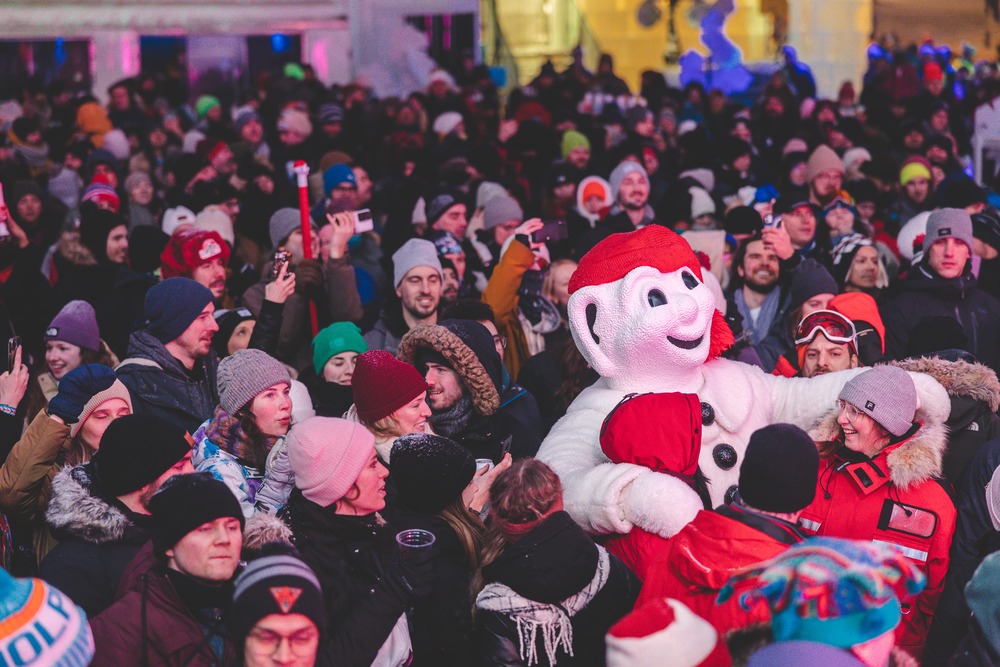
The first large winter Carnival in Québec City, the world's snow capital, took place in 1894. Often faced with winter’s hardships, the city's population reinvented this popular tradition with a winter celebration that warmed up the hearts of all of it revellers. Interrupted by two wars, then the economic crisis of 1929, the Carnival was held sporadically until the second half of the century. In 1954, in the context of the economic development of the Old Capital, a group of business people re-launched the festivities. That year, Bonhomme was born and elected the event’s representative. The first official edition of the Québec Winter Carnival took place in 1955. The Carnival snowballed into an undeniable manifestation for the entire Québec City population, and was an important vehicle for tourism and economical activity in the city.
From one winter to the next, the Carnival enriched its activity program. We have since added even more popular activities, such as winter sports, snow sculptures, and activities based on the traditional Québec lifestyle, such as canoe races and dogsled races. The Québec Winter Carnival is the largest winter carnival in the world today, and is third on the List of Top Carnivals after the famous carnivals in Rio and New Orleans.
From 1893 to 2004
Source : Jean Provencher - Le Carnaval de Québec, la grande fête de l'hiver
In the early 1890s, the North American economy was very slow. The Québec City area was particularly hard hit with the definitive closing of its shipyards and emerging problems in the shoe manufacturing industry. On October 19, 1893, the owner of the Quebec Daily Telegraph, Frank Carrel, used the columns of his newspaper to launch the idea of a new carnival in Québec City.
1894
In 1894, the float for the Timmons cider and carbonated beverage manufacturer is ready for the parade on the Côte d'Abraham.
1928
In the winter of 1928 on the corner of Buade and Des Jardins streets, the Club Automobile de Québec is justifiably proud of the ice sculpture in front of its offices.
1940
On a beautiful sunny afternoon in 1940 near Château Frontenac a dog handler trains his dog-sledding team for a race.
1954
Bundled up in warm clothing, the founders of the Carnival proudly wear the arrowhead sash as the snow falls on Québec City. Louis-Philippe Plamondon in the middle, Wilbrod Bherer on his right and Louis Paré on his left.
1955
First edition of the contemporary Québec Winter Carnival. Creation of the effigy. Bonhomme Carnaval makes his appearance surrounded by duchesses; the one who sells the most tickets will be proclaimed Queen of the Carnival. Until 1972, the Ice Palace was built in Place à D’Youville.
1956
Rue Saint-Louis, a group of snowshoers parade along on Mardi Gras day.

A picture of the big show at the Coliseum celebrating the coronation of the queen, with the theme song, "Dansons l'année!"

A great deal of preparation went into this magnificent masquerade party, held at the Coliseum.

A huge Mardi-Gras celebration at Port Saint-Louis.
1957
The Québec City area is divided into seven duchies. Each duchy is headed by a duchess. The duchy that sells the most tickets in favour of its duchess will win her the title of Queen of the Carnival. Until 1996, a downhill torchlight ski was held 31 times in Lac-Beauport.
1958
The ice canoe race takes place under the worst conditions in the history of this classic. Only 4 of the 21 teams make it to the finish line.
1959
To replace draw tickets, a new financing concept was created: the Carnival Candle. For the first time, the queen elected through a random draw.

The soapbox derby is now part of the program.

The float designed by Gaston Robert for the queen, Maryse Gaudette, at the upper town parade.
1960
In 1960, Carnival Street was born.
For the first time, Québec’s Premiere launched the Carnival. The residents of Rue Sainte-Thérèse created many snow or ice sculptures, and this location became known as Carnival Street. The new International Pee-Wee Hockey Tournament is included in the program. Until 1999, just about every year the floats were put on exhibit to let people get a closer look at them.
1961
First barrel-jumping competitions.
Until 1997 motorcycle races on the ice were held occasionally.
1962
In 1962, the Palace had a futuristic look. Word has it that the designer, architect André Robitaille, was inspired by a photograph of an iceberg taken in 1908 by Captain Joseph-Elzéar Bernier during one of his expeditions to the Far North. The workshops were built on Rue Joly and still exist today.
1963
Barrel jumping, part of the Carnival until the late 1980s, is now a sport of the past. Starting in 1940, most of the Canadian champions were Quebeckers. In 1963, for the first time, the Queen of the Carnival was crowned outdoors on the race track of the Exhibition grounds. Never before had the Carnival attracted such huge crowds.
1964
The name of Bonhomme Carnaval and his image become registered trademarks. Voûtes Chez Ti-Père opened on Rue Sainte-Thérèse.
1965
Creation of Place Carnaval in lower town’s Parc Victora. Many Carnival activities were held here. A Grand Prix auto race was held until 1978, and then again from 1984 to 1994. Until 1995, a chess tournament was held 18 times. Creation of the Order of Bonhomme.
1966
The first women’s team participated in the canoe race. In the summer, for the first public consultation on the Carnival, thousands of families received a questionnaire inviting them to share their opinions. The exercise was repeated the following year. Creation of the Order of Duchesses.
1967
Following the public consultations, the coronation of the queen was once again presented during a lightshow.
1968
In the annual report, this edition of the Carnival was called the “Carnival of Inovations”. The creation of inter-duchy games, the return of old activities like the Regency Ball, the parade of floats made by children and the big bonfire on the Plains of Abraham.
1969
Visit with Bonhomme at the Institut Saint-Joseph in Lévis.
1970
A new tradition is born: closing the event with a fireworks display. Until 1993, snowmobiling races were held sporadically. Bonhomme Carnaval became an ambassador and started travelling to promote the Québec Winter Carnival.
1971
The Ice Palace of 1971. That year, the Carnival had to deal with many snowstorms. The coronation of the queen was televised for the first time live from the Grand Théâtre, which had just opened.
1972
From this point on, the Gregorian calendar was no longer used to set the dates for the Carnival. It would end on a Sunday evening rather than on Mardi Gras.
1973
The Ice Palace was built on the esplanade in front of the Parliament Building, rather than in Place D’Youville. That same year on this spot called Place du Carnaval, the International Snow Sculpture Competition was held for the first time. That year, Quebeckers measured up to the French, the Americans and the Japanese. The official name of the event was modified as well: Carnaval d’hiver de Québec became Carnaval de Québec.
1974
At the 1973 and 1974 carnivals, Bobino (Guy Sanche) and Bobinette, characters from the much loved children’s TV show, came to Québec City to present four shows at the Drill Hall. Bobinette disguised himself as Bonhomme Carnaval, complete with a red tuque and an arrowhead sash…
Two weeks before the 20th Carnival opened, the roof of the Rue Joly workshop collapsed under the weight of snow and ice. Six floats, including that of Bonhomme and the Duchesses were lost, as well as 174 clown heads, 2 mermaids and 1 dolphin. The public’s sympathy manifested in record sales for the Carnival candle. Close to 346,000 candles were purchased. The Western breakfast was held for the first time. Until 1985, a moustache competition was also part of the festivities.
1975
January 1975. Total joy in the Coliseum. Bonhomme heads in for the face-off. The Carnival starts in a few days. The Nordiques have just acquired their star player, Marc Tardif (no 8). On his right, Jean-Claude Garneau. On his left, defence player Pierre Roy and goalie Serge Aubry. Behind Bonhomme, masked by his shoulder, defence player Mario Marois.
Creation of a new activity called The Break, on Friday from noon till midnight. Many employers give their employees time off so they can go dancing at the Québec City Convention Centre. The event continues to be held until 1986, sometimes late into the night. The Innu participate for the first time in the International Snow Sculpture Competition.
1976
A speed skating championship was held until 1992.
1977
Until 1991, the Carnival offered a children’s sculpture competition.
1978
Bonhomme goes to Poste-de-la-Baleine (became Kuujjuarapik in 1980), on the shores of Hudson Bay to make a quick visit to the Inuit who won the International Snow Sculpture Competition.
1979
Until 1992, the Palace was made of snow since there was no ice supplier in the area.
This year is the big 25th anniversary celebration.
1980
Creation of two new Carnival sites: Place des Enfants (1st winter playground dedicated to children) and Place du Manège (for Carnival get-togethers, such as social and public gatherings).
1981
The 1981 Ice Palace
The Effigy of Bonhomme Carnaval is sold everywhere in the Québec City area. An eccentric hairstyle and makeup contest was held until 1991.
1982
Bonhomme goes to Acapulco, Mexico, to represent the Carnival and the city of Québec during a tourism industry conference.
1983
Until 1994, the wax candle is replaced by a “scratch-and-win” candle, similar to a lottery ticket.
The first Night Parade in Charlesbourg.
1984
The Carnival celebrates its 30th anniversary.
1985
The first Business Leaders’ Breakfast is held.
1986
For the first time, because of abundant snowfall, the Carnival Candle Draw is postponed.
From now on, women’s teams participate in the canoe race.
1987
The snow bath becomes part of the program.
1988
The Carnival receives a visit from some Hollywood celebrities: international media coverage increases.
1989
For the first time, a woman becomes President of the Carnival.
1990
Place des Enfants is at Parc Cartier-Brébeuf, but moves to the Plains of Abraham and takes the name Place de la Famille.
1991
All Carnival activity ceases on Rue Sainte-Thérèse.
1992
The International Snow Sculpture Competition moves to the Plain of Abraham.
1993
The Palace is once again built of ice rather than snow.
1994
The Carnival celebrates its 40th anniversary.
1995
Return to the wax candle.
1996
Carnival managers choose to have a winter festival for the general public, with an emphasis on family. The activities are grouped together on two major sites: Esplanade de l’Hôtel du Parlement and the Plains of Abraham.
1997
One of the women’s teams in the 1997 canoe race. In the front port side of the boat, starboard, Dominique Grenier; back portside, Suzie Ketene; starboard, Nathalie Dufour. Captain: Stéphanie Drouin.
The move to making the Carnival more family-oriented begins. Disappearance of the duchies, the duchesses and the queen. The duchies are replaced by bonhomries.
1998
The knuks, mischievous little jokers from the North, make their appearance. These teasing and cheeky characters have the talents of magicians, dancers and pranksters. The arrival of a title sponsor.
1999
Because of the importance volunteers, the human resources department was created to improve organization (recruitment, training, recognition activities).
2000
A third permanent site opens at Place D’Youville. The Carnival decides to manage its own merchandise. The expertise of the Carnival Workshops makes it possible to take outside contracts.
2001
The Carnival wants to be the reference for winter tourism festivals in North America.
2002
The program is centred more on interactive activities (giant soccer game, ice fishing, snow sculptures). Creation of the Confrérie des bretelles de la bougie.
2003
Despite the coldest temperatures on record in the past ten years, the 2003 edition was a great success.
2004
The Carnival celebrates its 50th anniversary.
2008
The Carnival is the very first event to celebrate the 400th anniversary of the city of Québec. A new Parade is specially created for the occasion.
2010
The Carnival concentrates its activities on 2 main sites: Place Desjardins and Place Loto-Québec. Place Hydro-Québec is replaced by a huge outdoor stage on the Plains of Abraham, Scène Hydro-Québec, where many shows are presented.
2011
A Ferris wheel was set up in the heart of winter at Place Desjardins on the Plains of Abraham, providing fabulous views for Carnival-goers!
Québec Winter Carnival Dates Since 1955
| Years | Carnival Dates | Years | Carnival Dates |
|---|---|---|---|
| 1955 | January 1st to February 22 | 1990 |
February 1st to February 11 |
| 1956 | January 29 to February 14 | 1991 |
February 7 to February 17 |
| 1957 | January13 to March 15 | 1992 |
February 6 to February 16 |
| 1958 | February 1st to February 18 | 1993 |
February 4 to February 14 |
| 1959 | January 27 to February 10 | 1994 |
February 3 to February 13 |
| 1960 | February 13 to March 1st | 1995 |
February 2 to February 12 |
| 1961 | January 26 to February 14 | 1996 |
January 26 to February 11 |
| 1962 | February 15 to March 6 | 1997 |
January 31 to February 16 |
| 1963 | February 6 to February 26 | 1998 |
January 30 to February 15 |
| 1964 | January 23 to February 11 | 1999 |
January 29 to February 14 |
| 1965 | February 11 to March 2 | 2000 |
January 28 to February 13 |
| 1966 | February 10 to February 22 | 2001 |
January 26 to February 11 |
| 1967 | January 26 to February 7 | 2002 |
February 1st to February 17 |
| 1968 | February 14 to February 22 | 2003 | January 31 to February 16 |
| 1969 | February 5 to February 18 | 2004 | January 30 to February 15 |
| 1970 | January 28 to February 10 | 2005 |
January 28 to February 13 |
| 1971 | February 4 to February 23 | 2006 |
January 27 to February 12 |
| 1972 | February 2 to February 13 | 2007 |
January 26 to February 11 |
| 1973 | February 22 to March 4 | 2008 |
February 1st to February 17 |
| 1974 | February 7 to February 17 | 2009 |
January 30 to February 15 |
| 1975 | February 6 to February 16 | 2010 |
January 29 to February 14 |
| 1976 | February 5 to February 15 | 2011 |
January 28 to February 13 |
| 1977 | February 3 to February 13 | 2012 |
January 27 to February 12 |
| 1978 | February 2 to February 12 | 2013 |
February 1st to February 17 |
| 1979 | February 1st to February 11 | 2014 |
January 31 to February 16 |
| 1980 | February 7 to February 17 | ||
| 1981 | February 5 to February 15 | ||
| 1982 | February 4 to February 14 | ||
| 1983 | February 3 to February 13 | ||
| 1984 | February 2 to February 12 | ||
| 1985 | February 7 to February 17 | ||
| 1986 | February 6 to February 16 | ||
| 1987 | February 5 to February 15 | ||
| 1988 | February 4 to February 14 | ||
| 1989 | February 2 to February 12 |